

Biological Odor Control Wastewater: What Actually Works Long-Term


Biological odor control wastewater programs don't all work the same way, and that's easy to miss because the word "biological" gets used for two genuinely different interventions. One treats air. The other treats water. Both use bacteria. Only one of them stops the odor from forming in the first place.
What Biological Odor Control Actually Means Here
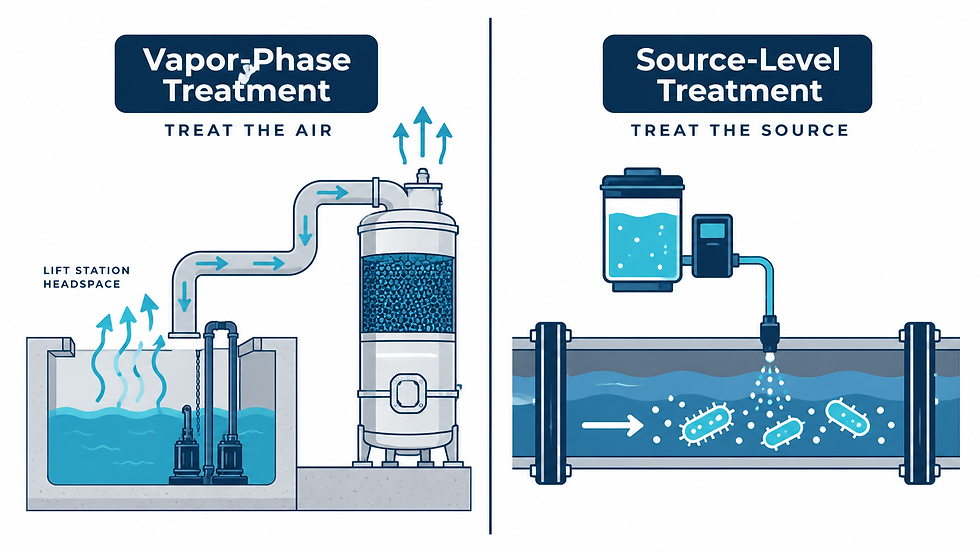
When most odor control literature says "biological," it's usually talking about biotrickling filters or bioscrubbers — vapor-phase systems that capture odorous air from a headspace (a lift station, a wet well, a treatment plant process) and route it through a bed or chamber where bacteria break down the odor compounds before the air is released.
These systems are a real improvement over older chemical scrubbing: one published retrofit study found a biotrickling filter saved a treatment plant roughly $30,000 a year compared to chemical scrubbing it replaced, while still handling the H2S load effectively.
That's a legitimate technology, not a strawman. It's also not the same thing as dosing bacteria upstream into the wastewater itself, which is the other thing "biological odor control" gets used to describe — including In-Pipe's approach.
What Vapor-Phase Systems Actually Require
Biotrickling filters and bioscrubbers work, but they come with real, ongoing operational requirements that are worth knowing before comparing them to anything else:
Continuous monitoring of pH and temperature inside the filter bed, since the bacteria need a maintained environment to keep functioning
Water and nutrient delivery to sustain the microbial population, plus trickle-rate control that directly affects removal efficiency
Sludge and wastewater byproduct from the treatment water itself, which has to be collected, stored, and properly disposed of — a waste stream the system creates, not just treats
An acclimation period before the system reaches full effectiveness, unlike a chemical scrubber that works immediately
Residual odor, even at steady state — published field data from biotrickling filters in continuous operation shows some odor consistently remains in the treated exhaust air, even when the system is working as designed
Clogging and biomass accumulation in the media bed over time, which can reduce mass transfer and removal performance if not managed
None of this makes vapor-phase treatment a bad choice. It makes it a system with real maintenance overhead, built to treat odor after it's already airborne.
Where Source-Level Treatment Fits Differently
Dosing bacteria directly into the collection system works by a different mechanism entirely — competitive exclusion that starves out the bacteria responsible for producing H2S in the first place, before it ever reaches a headspace that would need capturing and treating. There's no air to route through a filter bed, no filter media to monitor, and no treatment-water byproduct to dispose of, because the odor-causing compound is never formed at the concentration a vapor-phase system exists to handle.
That's not a claim that source treatment replaces every vapor-phase system already in place. A lift station with a severe, acute odor problem right now may still need vapor-phase capture as an immediate measure while an upstream program takes effect — bacteria introduced into a collection system take time to establish, the same way any biological population does.
The honest framing is that the two approaches solve for different things: one captures and treats odor that's already there, the other reduces how much odor forms to begin with.
How to Actually Decide
The useful question isn't "which is better" in the abstract — it's what's driving the odor complaint in the first place:
If a specific point source (a single lift station, a covered wet well) has odor concentrated enough to need active air capture, a vapor-phase system addresses that directly.
If odor complaints are showing up across multiple points in a collection system, or recurring at a lift station despite a vapor-phase unit already running there, that's a sign the H2S is being generated faster than the point-source system can keep up with — which is where upstream, source-level treatment changes the underlying math rather than just the capture rate.
A program built around both isn't contradictory. It's matching the tool to where the odor is actually being generated versus where it's already accumulated.
See Which Approach Fits Your System
If you're running a vapor-phase system and still fielding odor complaints, that's worth a second look — it may mean the generation rate has outgrown the capture rate, not that the equipment is failing. Talk to In-Pipe about where source-level treatment would fit alongside what you already have running.


Comments